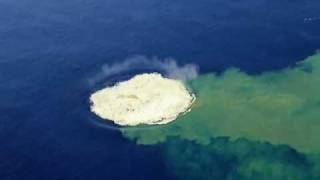
Nahum 1:5-6 The mountains quake at him, and the hills melt, and the earth is burned at his presence, yea, the world, and all that dwell therein. Who can stand before his indignation? and who can abide in the fierceness of his anger? his fury is poured out like fire, and the rocks are thrown down by him.
WAS GOD A VOLCANO? YES! GOD - ALLAH WAS A VOLCANO-VOLCANIC ACTIVITY!!!
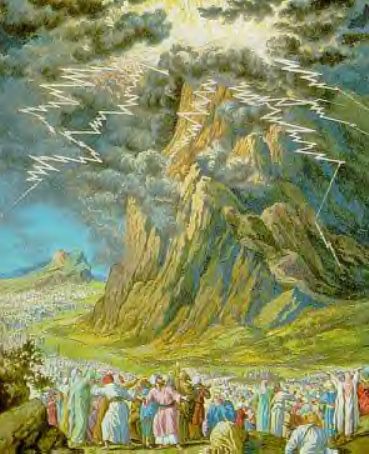
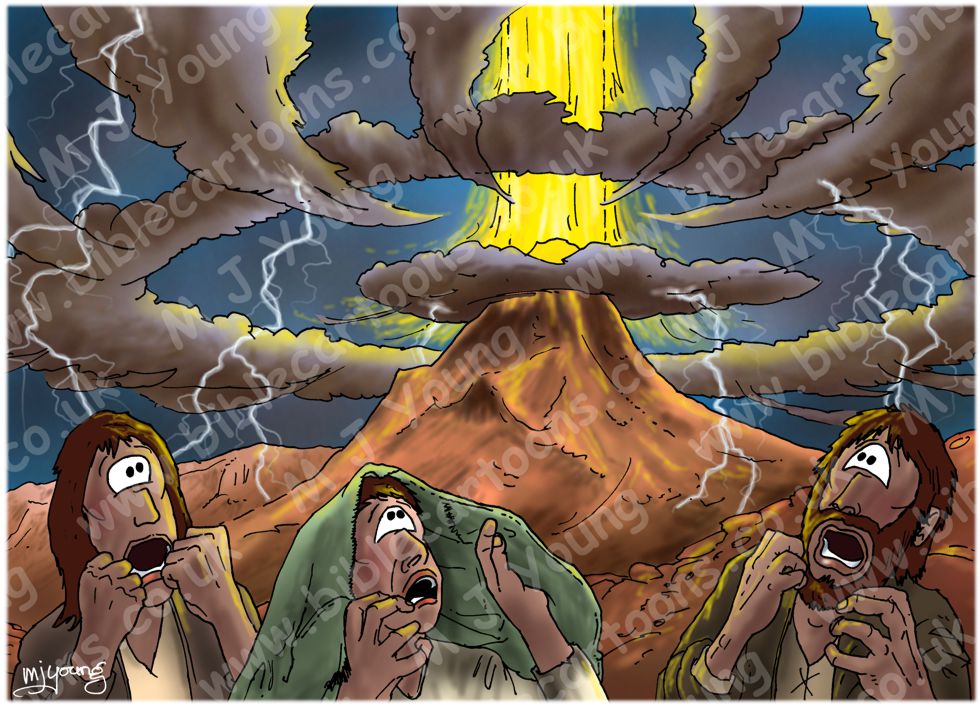
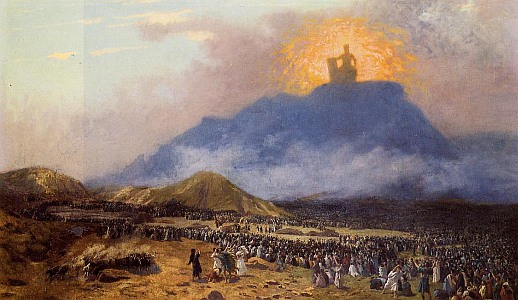
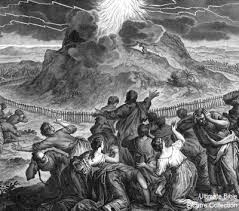
Mount Sinai, the 'mountain of fire' and 'mountain of god' mentioned in the Bible as depicted by cartoonists and artists who mostly seem blissfully unaware of what the numerous Bibilical verses have led them to recreate.
Exodus 34:29 And it came to pass, when Moses came down from mount Sinai with the two tables of testimony in Moses' hand, when he came down from the mount, that Moses wist not that the skin of his face shone while he talked with him.
Exodus 32:11 Then Moses pleaded with the Lord his God, and said: “Lord, why does Your wrath burn hot against Your people whom You have brought out of the land of Egypt with great power and with a mighty hand? 12 Why should the Egyptians speak, and say, ‘He brought them out to harm them, to kill them in the mountains, and to consume them from the face of the earth’? Turn from Your fierce wrath, and relent from this harm to Your people.
Exodus 19 1.On the first day of the third month after the Israelites left Egypt —on that very day—they came to the Desert of Sinai. 2 After they set out from Rephidim, they entered the Desert of Sinai, and Israel camped there in the desert in front of the mountain.
Deuteronomy 32:2 He said: "The LORD came from Sinai and dawned over them from Seir; he shone forth from Mount Paran. He came with myriads of holy ones from the south, from his mountain slopes.
Exodus 20:18 Now all the people witnessed the thunderings, the lightning flashes, the sound of the trumpet, and the mountain smoking; and when the people saw it, they trembled and stood afar off.
Exodus 19:12 You shall set bounds for the people all around, saying, ‘Take heed to yourselves that you do not go up to the mountain or touch its base. Whoever touches the mountain shall surely be put to death. 13 Not a hand shall touch him, but he shall surely be stoned or shot with an arrow; whether man or beast, he shall not live.’ When the trumpet sounds long, they shall come near the mountain.”
Exodus 19:16 Then it came to pass on the third day, in the morning, that there were thunderings and lightnings, and a thick cloud on the mountain; and the sound of the trumpet was very loud, so that all the people who were in the camp trembled. 17 The sight of the glory of the Lordwas like a consuming fire on the top of the mountain in the eyes of the children of Israel. 18 So Moses went into the midst of the cloud and went up into the mountain.
Exodus 24 15 Then Moses went up into the mountain, and a cloud covered the mountain.
16 Now the glory of the Lord rested on Mount Sinai, and the cloud covered it six days. And on the seventh day He called to Moses out of the midst of the cloud.
Exodus 19:17 And Moses brought the people out of the camp to meet with God, and they stood at the foot of the mountain. 18 Now Mount Sinai was completely in smoke, because the Lord descended upon it in fire. Its smoke ascended like the smoke of a furnace, and the whole mountain[a] quaked greatly.
Now contrast the Biblical verses above that led the artists to create the volcanic imagery with the Open Bible's list of verses. Nothing volcanic whatsoever. That is what you call religiously ordained deception.
Now please see this list of Biblical verses that suggest the god of the ancient Hebrews, and therefore the Abrahamic religions, was nothing other than anthropomorphised volcanic activity.
Below is a part of a thread posed by someone wanting to know why volcanoes are not mentioned in the Bible.
Inthe Bible we have Floods, Storms, Earthquakes, Winds, etc. All being some part of a punishment from God. But volcano's are not mentioned as even existing, yet they have caused much damage in history, and even in recent times we see volcano's coming alive. Can anyone tell me where thewordVolcano appears intheBible.
If i remember right: The wordvolcano was first used by the Romans as the god of fire, vulcano.......it's notinthebible.
Ok, then that's good enough for me. Thank you Chaplain Eldermike.
So, despite him at first pointing out that everything else is mentioned in the Bible so volcanoes should also be there......he comforts himself with the answer.....they're not mentioned in the Bible.
So easily placated. Like putting a dummy into a baby. Your moment of enlightenment is over. Now back to la la land.
This article proves three things........that there are still people who believe chucking a chicken into a volcano will stop it erupting, that Hinduism includes volcano appeasement (worship?) and that there's always money to be thrown away and people to grab it in religion.
Femme de la Rue is a short film (now deleted from youtube...see below) produced by a Belgian woman due to her experiences of sexual harassment by 'foreign' men, foreign obviously being a politically correct way of avoiding the use of the word 'muslim'. I know only too well what these woman speak of. Finally, women are speaking out....but, I fear, it's too late. The Belgians produce too few babies and the muslims produce too many. Westernised women will find it increasingly difficult to find areas to live in free of this hostility, hence the main reason for this blog, which is about the theory that Yahweh, the god of the ancient Hebrews, was nothing other than anthropomorphised VOLCANIC ACTIVITY. Please see this list.
Sorry but the video has been removed by the author. Has she been threatened? Here it is elsewhere....
In its place....number one on Youtube for 'femme de la rue' is now this video, made by someone from Sharia4Belgium. I don't speak Arabic but I suspect this video is not aimed at educating the muslims of Brussels on how to treat the infidel women with respect.
Quote below on the Red Sea volcanic activity taken from here...
The Red Sea was formed by Arabia splitting from Africa due to movement of the Red Sea Rift. This split started in the Eocene and accelerated during the Oligocene. The sea is still widening and it is considered that the sea will become an ocean in time (as proposed in the model of John Tuzo Wilson). In 1949, a deep water survey reported anomalously hot brines in the central portion of the Red Sea. Later work in the 1960s confirmed the presence of hot, 60 °C (140 °F), saline brines and associated metalliferous muds. The hot solutions were emanating from an active subseafloor rift. The highly saline character of the waters was not hospitable to living organisms.[15]
Sometimes during the Tertiary period the Bab el Mandeb closed and the Red Sea evaporated to an empty hot dry salt-floored sink. Effects causing this would be:
•A "race" between the Red Sea widening and Perim Island erupting filling the Bab el Mandeb with lava. •The lowering of world sea level during the Ice Ages due to much water being locked up in the ice caps. A number of volcanic islands rise from the center of the sea. Most are dormant, but in 2007 Jabal al-Tair island, in the Bab el Mandeb strait, erupted violently. An eruption among the nearby Zubair islands followed in 2011.[16]
Please see my earlier posts on one 'mythical monster', the Leviathan, which I believe was zoomorphised submarine volcanic activity.
I believe the Leviathan is a very distinct creature of the Bible and different to the usual 'sea monster', which I believe was a Nile crocodile. The Leviathan had many characteristics that do not fit a crocodile or any other animal.
If the ancient Hebrews had a specific name for their underwater volcano monster, other civilisations will also have named their respective volcano monsters.....and maybe the fear and zoomophism of them was something everyone in the volcanic Holy Land had in common. Maybe the stories of them started in one civilisation and were passed down into another.
One sea monster, which is described as mythological when it might in fact be fabled, is the Lernaean Hydra.
serpent-like chthonic water beast, with reptilian traits, (as its name evinces) that possessed many heads — the poets mention more heads than the vase-painters could paint, and for each head cut off it grew two more — and poisonous breath so virulent even her tracks were deadly. Upon reaching the swamp near Lake Lerna, where the Hydra dwelt, Heracles covered his mouth and nose with a cloth to protect himself from the poisonous fumes. He fired flaming arrows into the Hydra's lair, the spring of Amymone, a deep cave that it only came out of to terrorize neighboring villages. the stench of the river Anigrus in Elis, making all the fish of the river inedible, was reputed to be due to the Hydra's poison.
It ravaged the country of Lernae near Argos, and dwelt in a swamp near the well of Amymone. However, with the assistance of his faithful servant Iolaus, he burned away the heads of the hydra, and buried the ninth or immortal one under a huge rock.
Statius, Thebaid 2. 375 ff (trans. Mozley) (Roman epic C1st A.D.) :
"The marsh of Lerna and the burnt Hydra’s heat makes warm the depths of those unrighteous waters."
The Hydra had the body of a serpent and many heads (the number of heads deviates from five up to one hundred there are many versions but generally nine is accepted as standard), of which one could never be harmed by any weapon. Also the stench from the Hydra's breath was enough to kill man or beast. When it emerged from the swamp it would attack herds of cattle and local villagers, devouring them with its numerous heads. It totally terrorized the vicinity for many years.
That's enough of Hydra for now but I hope you can see the traits of an underwater gas leaking volcano. The herds were attacked by gas leaks, which is very reminiscent of the first born deaths in Exodus and the deaths in Job. The inability to kill it with weapons also aligns it with the Leviathan.
CHIMAERA (Chimaira), a fire-breathing monster, which, according to the Homeric poems, was of divine origin. She was brought up by Amisodarus, king of Caria, and afterwards made great havoc in all the country around and among men. The origin of the notion of this fire-breathing monster must probably be sought for in the volcano of the name of Chimaera near Phaselis, in Lycia (Plin. H. N. ii. 106, v. 27; Mela. i. 15), or in the volcanic valley near the Cragus (Strab. xiv. p. 665, &c.), which is described as the scene of the events connected with the Chimaera.
Please see the link above for many examples of how ancient people used many animal names to describe just one nameless 'monster'...something they simply didn't recognise.
Ngauruhoe, Tongariro, White Island and the Fire Demons
The volcanoes Ngauruhoe, Tongariro and White Island are present in a Maori legend. A medicine man named Ngatoro was climbing up Tongariro with a woman named Auruhoe. He told his followers not to eat while he was gone in order to give him strength on top of the cold mountain. When Ngatoro didn't return for some time, his followers thought him to be dead, and they broke their fast. Ngatoro and Auruhoe immediately began to feel the cold, and Ngatoro prayed to his sisters in the faraway land of Hawaiki. The sisters called upon fire demons that began swimming underwater toward Ngatoro. They first came out of the water at White Island to see where they were, and the land burst into flames that are still burning. The demons continued on underwater until they reached Ngatoro and burst through the summit of the mountain, thus creating the volcano Ngauruhoe. Ngatoro was saved by the warmth, but Auruhoe had already died. Ngatoro then took Auruhoe's body and threw it into the volcano. The underwater path of the fire demons can still be seen, for everywhere they surfaced is now a thermal area (Vitaliano, 1973).
TYPHON (TYPHAON, TYPHOEUS), in Greek mythology, youngest son of Gaea and Tartarus. He is described as a grisly monster with a hundred dragons' heads, who was conquered and cast into Tartarus by Zeus. In other accounts, he is confined in the land of the Arimi in Cilicia (Iliad, ii. 783) or under Etna (Aeschylus, P.V. 370) or in other volcanic regions, where he is the cause of eruptions. Typhon is thus the personification of volcanic forces. Amongst his children by Echidna are Cerberus, the Lernaean hydra, and the Chimaera.
Typhon had frightful features and enormous powers. Soon, he attacked the home of
the gods, flaming rocks at it, hissing, screaming and gushing mighty streams of
fire from his mouth.
So, there seems to be a whole family of volcano monsters that instead of being described as myths should be described as fables because there is truth behind the tale...or should I say tail? And these are just the Hebrew one and the Greek ones. Apparently there is an Ethiopian one too...another day.
When the Leviathan is hungry, reports R. Dimi in the name of R. Johanan, he sends forth from his mouth a heat so great as to make all the waters of the deep boil, and if he would put his head into Paradise no living creature could endure the odor of him (ib.). His abode is the Mediterranean Sea; and the waters of the Jordan fall into his mouth (Bek. 55b; B. B. l.c.).
One thing is for sure, these monsters had breath that could kill.
Could the story of the Leviathan have originated from Kolumbo, which is a submarine volcano near to Santorini?
Kolumbo is an active submarine volcano in the Aegean Sea, about 8 km northeast of Cape Kolumbo, Santorini island. The largest of a line of about twenty submarine volcanic cones extending to the northeast from Santorini,[1] it is about 3 km in diameter with a crater 1.5 km across.[2] It was "discovered" when it breached the sea surface in 1649-50, but its explosion was not to be compared to the well-known Thera explosion and caldera collapse, currently dated ca. 1630 BCE, with its devastating consequences for Minoan civilization.
conservative scholars cite Eusebius (AD 263-399), who placed Job "two ages before Moses" or 2,000-1,500 BC.[14
The 1650 eruption was a very explosive event and ejected pumice and ash as far as Turkey, and produced pyroclastic flows that killed about 70 people on Santorini. During the eruption, it constructed a temporary island (hence it's name Kolumbo, in Greece "swimming"). A tsunami occurred as well, probably during the collapse of the cone. It caused damage on nearby islands up to 150 km and invaded the flat coastal areas especially on the eastern side of Santorini, where ruins from Roman times were uncovered. The eruption also caused damage killed a great number of livestock because of poisonous gasses, mainly H2S.
7000 sheep burned up by 'The fire of God which fell from the sky. and the house of the firstborn destroyed by a mighty wind, killing all of Job's offspring. Satan, therefore, smites him with dreadful boils, and Job, seated in ashes, scrapes his skin with broken pottery.
..............................................
Could the Book of Job, or at least some of it, be based on the lives of Santorini volcano worshippers prior to them fleeing as refugees to Egypt? Could the idea of the saviour and adversary be based on a land volcano (the one they gave burnt offerings to) and a submarine volcano (the one they threw spears at to no avail)?
'God'....the one most people think of, was the god of the ancient Hebrews.....a volcano god....but he was just one of thousands of gods.
Watch the video above to view the long list of gods that human imagination has managed to create. When god worship finally becomes a universally laughable passtime, the human race will suddenly dazzle due to all that creative energy being diverted towards more worthy projects.
Do you believe in god? Which one of the thousands do you believe in? So, your god was the 'one true god'? Can you give me the name of even just one of the thousands of rejects that was ever promoted as an untrue god?
Maybe someone out there can give me some impartial expert assistance on this little find....
It seems that the word 'Pele' was used in the Bible but has now been purged from it.
pele'
1) wonder, marvel
1a) wonder (extraordinary, hard to understand thing)
1b) wonder (of God' s acts of judgment and redemption)
Pele is used 13 times in the Hebrew Bible but has been swapped for 'wonders'.
Exodus 15:11: "fearful in praises, doing wonders?" Psalms 77:11: "of the LORD: surely I will remember thy wonders of old." Psalms 77:14: "Thou art the God that doest wonders: thou hast declared thy strength among the people." Psalms 78:12: " Marvelous things did he in the sight of their fathers, in the land of Egypt, in the field of Zoan." Psalms 88:10: "Wilt thou show wonders to the dead? shall the dead arise and praise thee? Selah." Psalms 88:12: " Shall thy wonders be known in the dark? and thy righteousness in the land of forgetfulness?" Psalms 89:5: "And the heavens shall praise thy wonders, O LORD: thy faithfulness also in the congregation of the saints." Psalms 119:129: "Thy testimonies are wonderful: therefore doth my soul keep" Isaiah 9:6: "and his name shall be called Wonderful, Counselor, The mighty God, The everlasting" Isaiah 25:1: "thy name; for thou hast done wonderfulthings; thy counsels of old are faithfulness" Isaiah 29:14: "this people, even a marvelous work and a wonder: for the wisdom of their wise men shall perish, and the understanding" Lamentations 1:9: "not her last end; therefore she came down wonderfully: she had no comforter. O LORD, behold" Daniel 12:6: "the waters of the river, How long shall it be to the end of these wonders?"
The name 'Pele' in Hawaiian means 'lava' and the word for volcano is 'lua pele'.
“Wonder” or “astonishment” define this Hebrew word. It means that which is “unusual” or “extraordinary” to such a degree it astonishes the witnesses and provokdes wonder. Again, it is the state of something being beyond the ordinary or beyond what is humanly possible such that one is awe-struck. More here.
Lava from the volcano god Pele in Hawaii and lava from the volcano god Yahweh would certainly have astonished the witnesses and provoked wonder.
And this hysterical article referencing a book called 'Perpetuated in Righteousness' disputing the possibility the Hawaiians, as well as the Incas, worshipped Yahweh. Well, they are connected in one aspect at least......volcanic activity worship.
Psalms explained..........halfway through them and these are the volcanic highlights.....
my king upon my holy hill of Zion, he heard me out of his holy hill, I worship toward thy holy temple, O Lord, rebuke me not in thine anger, neither chasten me in thy hot displeasure, So shall the congregation of the people compass thee about: (the people shall circle the volcano) for their sakes therefore return thou on high, the Lord, which dwelleth in Zion (not omnipresent then), my soul, Flee as a bird to your mountain? The Lord is in his holy temple, Upon the wicked he shall rain snares, fire and brimstone, and an horrible tempest, who shall dwell in thy holy hill? The Lord is my rock and my high tower, he heard my voice out of his temple, Then the earth shook and trembled; the foundations also of the hills moved and were shaken, because he was wroth, There went up a smoke out of his nostrils, and fire out of his mouth devoured: coals were kindled by it. At the brightness that was before him his thick clouds passed, hail stones and coals of fire. The Lord also thundered in the heavens, and the Highest gave his voice; hail stones and coals of fire. Yea, he sent out his arrows, and scattered them; and he shot out lightnings, and discomfited them. Then the channels of waters were seen, and the foundations of the world were discovered at thy rebuke, O Lord, at the blast of the breath of thy nostrils. who is a rock save our God? and blessed be my rock; Thou shalt make them as a fiery oven in the time of thine anger: the Lord shall swallow them up in his wrath, and the fire shall devour them. when thou shalt make ready thine arrows upon thy strings against the face of them. Who shall ascend into the hill of the Lord? or who shall stand in his holy place? so will I compass thine altar, O Lord. O Lord my rock. when I lift up my hands toward thy holy oracle. The voice of the Lord is powerful; the voice of the Lord is full of majesty. The voice of the Lord divideth the flames of fire. The voice of the Lord shaketh the wilderness; the Lord shaketh the wilderness of Kadesh. be thou my strong rock, For thou art my rock and my fortress. He gathereth the waters of the sea together as an heap (tsunami), into smoke shall they consume away. rebuke me not in thy wrath: neither chasten me in thy hot displeasure. For thine arrows stick fast in me, God my rock, O send out thy light: let them lead me; let them bring me unto thy holy hill, Thine arrows, though the earth be removed, and though the mountains be carried into the midst of the sea; Though the waters thereof roar and be troubled, though the mountains shake with the swelling thereof. the earth melted. behold the works of the Lord, what desolations he hath made in the earth. For the Lord most high is terrible. God is gone up with a shout, the Lord with the sound of a trumpet. God sitteth upon the throne of his holiness. in the mountain of his holiness. Out of Zion, the perfection of beauty, God hath shined. a fire shall devour before him, pay thy vows unto the most High, Let them melt away as waters which run continually: when he bendeth his bow to shoot his arrows, lead me to the rock that is higher than I. Say unto God, How terrible art thou in thy works! As smoke is driven away, so drive them away: as wax melteth before the fire, so let the wicked perish at the presence of God. The hill of God is as the hill of Bashan; an high hill as the hill of Bashan. Why leap ye, ye high hills? this is the hill which God desireth to dwell in; yea, the Lord will dwell in it for ever. The chariots of God are twenty thousand, even thousands of angels: the Lord is among them, as in Sinai, in the holy place. Pour out thine indignation upon them, and let thy wrathful anger take hold of them. Let their habitation be desolate; and let none dwell in their tents. whom thou hast wounded. thou art my rock and my fortress. O God, is very high, who hast done great things. The mountains shall bring peace to the people, and the little hills, by righteousness. why doth thine anger smoke against the sheep of thy pasture? mount Zion, wherein thou hast dwelt. Thou didst cleave the fountain and the flood: thou driedst up mighty rivers. his dwelling place in Zion. thou art more glorious and excellent than the mountains of prey. who may stand in thy sight when once thou art angry? let all that be round about him bring presents unto him that ought to be feared. I will remember the years of the right hand of the most High. I will remember the works of the Lord. thine arrows also went abroad. The voice of thy thunder was in the heaven: the lightnings lightened the world: the earth trembled and shook.
Yes, Yahweh was a volcano god. See this to get you started.
What is a Leviathan? A zoomorphised underwater volcanic eruption that the ancient Hebrews believed was a sea monster. I am listing at the bottom all academic recipients of my email linking to this page and will note the responses so other people can see what the expert community makes of my theory and whether or not it is receptive to fresh ideas. Expert contributions will be greatly appreciated.
If you believe in this theory, please leave a comment, which can be done anonymously, and pass the link on.
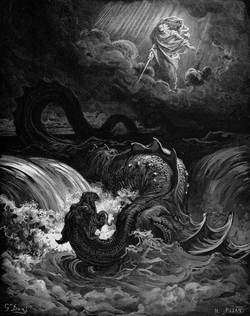
The accepted imagery of the Leviathan.
Please also keep in mind that every single theology and mythology expert could believe the Leviathan was a mythological sea monster but they could also all be wrong or their beliefs could be incomplete.
The original Leviathan. .
How many serpents have bones as strong as iron, can somehow remove all the water of a river (like a tsunami), shoot out snares/burning lamps/sparks/smoke/flames, can kindle coals, is as hard as stone, is impossible to kill, shoots out sharp pointed things under the sea, makes the sea boil and turns the sea a different colour? .
The ancient Hebrews, living in around rift zones where continents are pulling apart, may well have experienced submarine volcanoes in deep or shallow waters....the Jordan River, the Dead Sea, the Nile, the Red Sea, etc. The story of the Leviathan may have been handed down through generations and have originated somewhere else. One thing is certain though; if the ancient Hebrews had witnessed a submarine volcano they would not have known what it was and they would have given it animal or human characteristics, as they did all awesome natural phenomena. Due to ignorance of the world around them, everything was mysterious. Even today, people are spooked by submarine volcanoes.
There is absolutely no evidence to suggest the Leviathan was originally mythological. The way it is written about in the Bible suggests it was viewed as very real. The ancient Hebrews believed in its existence and they clearly feared it and even made attempts to kill it, which means it was not originally mythological but something born out of fear of the misunderstood.
Wiki...'When the Leviathan is hungry, reports R. Dimi in the name of R. Johanan, he sends forth from his mouth a heat so great as to make all the waters of the deep boil, and if he would put his head into Paradise no living creature could endure the odor of him (ib.). His abode is the Mediterranean Sea; and the waters of the Jordan fall into his mouth (Bek. 55b; B. B. l.c.).'
Submarine volcanoes produce lots of sulfur, which smells like rotten eggs.
Job 40
16 Lo now, his strength is in his loins, and his force is in the navel of his belly. 17 He moveth his tail like a cedar: the sinews of his stones are wrapped together. 18 His bones are as strong pieces of brass; his bones are like bars of iron. 23 Behold, he drinketh up a river, and hasteth not: he trusteth that he can draw up Jordan into his mouth. 24 He taketh it with his eyes: his nose pierceth through snares.
Job 41 19 Out of his mouth go burning lamps, and sparks of fire leap out. 20 Out of his nostrils goeth smoke, as out of a seething pot or caldron. 21 His breath kindleth coals, and a flame goeth out of his mouth. 23 The flakes of his flesh are joined together: they are firm in themselves; they cannot be moved. 24 His heart is as firm as a stone; yea, as hard as a piece of the nether millstone. 26 The sword of him that layeth at him cannot hold: the spear, the dart, nor the habergeon. 27 He esteemeth iron as straw, and brass as rotten wood.28 The arrow cannot make him flee: slingstones are turned with him into stubble.29 Darts are counted as stubble: he laugheth at the shaking of a spear. 30 Sharp stones are under him: he spreadeth sharp pointed things upon the mire. 31 He maketh the deep to boil like a pot: he maketh the sea like apot of ointment. 32 He maketh a path to shine after him; one would think the deep to be hoary.
There is nothing in Job 41 that discounts this theory but all of the above not only point directly to it but discount anything made of flesh, either mythical or real. 'Hoary' means 'white hair', so a path flowing from the Leviathan that looks like white hair could be this or this...
I have included parts of Job 40 because I believe Bohemoth and Leviathan merge. The important point is that the ancients misunderstood submarine volcanoes for monsters.
Job 40 23-24 Behold, he drinketh up a river, and hasteth not: he trusteth that he can draw up Jordan into his mouth. He taketh it with his eyes: his nose pierceth through snares.
I believe the above verses are nowadays misinterpreted. Job 40:24 I believe means the water of the river Jordan seemed to drain into the Bohemoth's eyes (in the minds of the Hebrews) as well as its mouth (in Job 40:23) and his nose (zoomorphically speaking) shot out snares.
'Snares' are nowadays interpreted as rings through the Bohemoth's nose. There is a problem with this interpretation. The verse would read the other way around....'Snares pierceth through his nose' if it was a ring through the nose to signify being captured. However, it is the nose that pierceth out snares. Snares, in this instance, are blazing coals, much as they are here....
'Upon the wicked he shall rain snares, fire and brimstone, and an horrible tempest: this shall be the portion of their cup.' Psalm 11:6
.
The above video of course not only demonstrates the Leviathan characteristics, it also talks about toxic gases being released and shows dead fish and reports on sick people, a correlation of which can be made with another submarine volcanic eruption....Kolumbo.
The Red Sea, the Dead Sea, the Suez Canal and most likely the Sea of Galilee all contain submarine volcanoes. Most volcanoes are submarine volcanoes and not land volcanoes.
Submarine volcanoes are underwater fissures in the Earth's surface from which magma can erupt. They are estimated to account for 75% of annual magma output. The vast majority are located near areas of tectonic plate movement, known as ocean ridges. Although most are located in the depths of seas and oceans, some also exist in shallow water, which can spew material into the air during an eruption.Hydrothermal vents, sites of abundant biological activity, are commonly found near submarine volcanoes.
One of Israel's tourist attactions is its hot springs. See this page for an extensive list of hydrothermal activity sites.
In 1949, a deep water survey reported anomalously hot brines in the central portion of the Red Sea. Later work in the 1960s confirmed the presence of hot, 60 °C (140 °F), saline brines and associated metalliferous muds. The hot solutions were emanating from an active subseafloor rift. The highly saline character of the waters was not hospitable to living organisms.[21] The brines and associated muds are currently under investigation as a source of mineable precious and base metals. From Wikipedia.
A very early hint of hydrothermal vents came in the 1880s when a Russian ship, Vitaz, sampled waters 600 meters (2,000 feet) deep in the Red Sea off the sacred city of Mecca. Read more here.
This page contains an image that shows the Dead Sea Transform Fault, one area that will almost certainly be lined with volcanic activity.
And here is some information on the Great Rift Valley.
Please also see my post on Mythical Monsters, which shows the volcanic correlation between several mythical monsters, including the Leviathan.
The above page on Mythical Monsters shows the common use of serpent imagery in 'mythical' or fabled monsters with volcanic origins. The serpent represents the slithering lava rivers. It has even been used by the Mayans when designing their volcano replicas...pyramids; a serpent is seen slithering down the side. Just because something is given serpent attributes does not mean it was a serpent. Such terminology could reflect a lack of understanding and a lack of the necessary vocabulary. The evils the ancients knew of were used to describe the evils they did not know about.
This absorbing book shows that myths originally transmitted real information about real events and observations, preserving the information sometimes for millennia within nonliterate societies. Geologists' interpretations of how a volcanic cataclysm long ago created Oregon's Crater Lake, for example, is echoed point for point in the local myth of its origin. The Klamath tribe saw it happen and passed down the story--for nearly 8,000 years. We, however, have been literate so long that we've forgotten how myths encode reality. Recent studies of how our brains work, applied to a wide range of data from the Pacific Northwest to ancient Egypt to modern stories reported in newspapers, have helped the Barbers deduce the characteristic principles by which such tales both develop and degrade through time. Myth is in fact a quite reasonable way to convey important messages orally over many generations--although reasoning back to the original events is possible only under rather specific conditions.
The above is a summation of a book just recommended to me, which I believe fits my beliefs on the 'myth' of the Leviathan....the fabled submarine volcano. The book is 'When they severed Earth from Sky' by Elizabeth Wayland Barber and Paul Barber.
Below is a quote from 'Decode Hindu Mythology' which uncovers the Leviathan of Hinduism....the Vadava....
Shiv Purana [2.3.20.14-19] states
that the fall off of this energy fell like lightning from Shiva’s third
eye and Brahma had to take it to the ocean and keep it safe there else
it would have burnt the entire creation. This mare shaped sub-marine
fire at the bottom of the ocean, is known as Vadava.
Normally, the fire is kept in check with the waters of the Global Ocean. But as Mahabharat
verse 12.248.13-17 state, the end of the Day of Brahma is nigh that
Rudra sparks off the fire again and this explosion of fire from the
mare's mouth in the Southern Ocean will begin the process of Pralaya.
Could this sub-marine fire actually refer to underwater volcanoes that
keep spewing out magma from the Earth's core. Maybe the end of our days
will be initiated by an under-water volcanic eruption that sets a chain
of events in motion leading to the annihilation of life as we know it!
Here is the list of experts in the field of mythology or religion who received a link to this page and a request to respond with an appraisal of the theory. I shall continue to contact more people and will update the list regularly so you can see the feedback.
.
James Aitken University of Cambridge
Sarah Coakley University of Cambridge
Eamon Duffy University of Cambridge
David Ford University of Cambridge
Dr Simon Gathercole University of Cambridge
Darren Sarisky University of Cambridge
Judith Lieu University of Cambridge
Janet Soskice University of Cambridge
Catherine Pickstock University of Cambridge
Fraser Watts University of Cambridge
Daniel Weiss University of Cambridge
John Day Oxford Univeristy (My theory is nonsense.)
Sondra Hausner Oxford University
Jack Jarick Oxford University
Will Kynes Oxford University
Guy Stroumsa Oxford University
Susan Gillingham Oxford University
Marcus Bockmuehl Oxford University
John Barton Oxford University
Ronald Hendel Berkeley University
Evans Lansing Smith Pacifica University
Christine Downing Pacifica University
Laura S.Grilla Pacifica University
Dennis Patrick Slattery Pacifica University
Glen Slater Pacifica University
Verlyn Flieger University of Maryland(Not an expert in this field)
Sheila Jelen University of Maryland
Susan Hollis Empire State College (Not her field of expertise)
Vanda Zajko University of Bristol
Richard Buxton University of Bristol
Susan Abraham University of Harvard
Emily Click University of Harvard
Francis Clooney University of Harvard
Mark Edwards University of Harvard
William Graham University of Harvard
David Hempton University of Harvard
Michael D.Jackson University of Harvard
Karen L.King University of Harvard
Peter Machinist University of Harvard
Dan McKanan University of Harvard
Diane L.Moore University of Harvard
Ahmed Ragab University of Harvard
Andrew Teeter University of Harvard
Ronald Theimann University of Harvard
Charlotte Elisheva Fonrobert Stanford University
Robert C. Gregg Stanford University
Kathryn Gin Lum Stanford University
Steven P. Weitzman Stanford University
John Gager Princeton University
Simeon Chavel University of Chicago
Michael Fishbane University of Chicago
David Schloen University of Chicago
Jeffrey Stackert University of Chicago
Arnold I. Davidson University of Chicago
Michael Fishbane University of Chicago
Paul Mendes-Flohr University of Chicago
James T. Robinson University of Chicago
Paul Mendes-Flohr University of Chicago
Steven Fraade Yale University
Robert Wilson Yale University
John Hare, Yale University
Kathryn Tanner Yale University
Ofra Backenroth The Jewish Theological Seminary
Samuel Barth The Jewish Theological Seminary
Meredith Katz The Jewish Theological Seminary
Sarah Tauber The Jewish Theological Seminary
Beth Berkowitz The Jewish Theological Seminary
Alan Cooper The Jewish Theological Seminary
Aryeh Davidson The Jewish Theological Seminary
Eliezer Diamond The Jewish Theological Seminary
Arnold Eisen The Jewish Theological Seminary
Shira Epstein The Jewish Theological Seminary
Eitan Fishbane The Jewish Theological Seminary
David Fishman The Jewish Theological Seminary
Israel Francus The Jewish Theological Seminary
Shamma Friedman The Jewish Theological Seminary
Benjamin Gampel The Jewish Theological Seminary
Stephen Garfinkel The Jewish Theological Seminary
Stephen A. Geller The Jewish Theological Seminary
Neil Gillman The Jewish Theological Seminary
Michael Greenbaum The Jewish Theological Seminary
Robert Harris The Jewish Theological Seminary
Judith Hauptman The Jewish Theological Seminary
Walter Herzberg The Jewish Theological Seminary
Amy Kalmanofsky The Jewish Theological Seminary
Richard Kalmin The Jewish Theological Seminary
David Kraemer The Jewish Theological Seminary
Jeffrey Kress The Jewish Theological Seminary
Nitza Krohn The Jewish Theological Seminary
Marjorie Lehman The Jewish Theological Seminary
Anne Lapidus Lerner The Jewish Theological Seminary
Leonard Levin The Jewish Theological Seminary
David Marcus The Jewish Theological Seminary
Carol Bakhos UCLA
David Myers UCLA
Chaim Seidler-Feller UCLA
I have already made a few posts about the plague of hail and they can be found by Googling 'oh my volcano hail'.
I am making this post to demonstrate why it is important to read all Bible translations and not just stick to a dreadful NIV or, heaven forbid, a 'Good News' version, the latter being certain to make you feel good but also garaunteed to make a fool out of you.
Exodus 9:24
NIV - hail fell and lightning flashed back and forth. It was the worst storm in all the land of Egypt since it had become a nation.
(No mention of the hail being intermingled with the lightening, which was in fact fire and not lightening.)
New Living Translation - Never in all the history of Egypt had there been a storm like that, with such devastating hail and continuous lightning.
(Words fail me. The translator needs sacking.....at least.)
King James Bible - Never in all the history of Egypt had there been a storm like that, with such devastating hail and continuous lightning.
Now we're getting to the facts. It's revealing that the newer the translation, the fewer volcano references there are to be found. I smell a cover-up.
Anyway, was it lightening or fire? If we assume the earlier verses are the most honest, fire it is. As I've said, this subject has been covered before (my findings being that the hail of Exodus was not normal ice hail but volcanic hail....either hail and fire mingled together or sulfur balls caught up in a cloud and deposited in Egypt) but here is something else I wanted to add....
Job 41:19 SEE HERE also shows how the word 'lightening' is used to hide the word 'burning torches' or 'burning lamps'.
And Job 41:19 leads me nicely to my next post.....which will appear shortly.
Allah does not appear to have been omnipresent, given these verses.......more likely he was sitting on the top of volcanoes, being an imaginery volcano god....
'The Most Merciful rose over the Throne'(20:5) 'Then He rose over the Throne...' (32:4) 'Then He rose over the heaven when it was smoke' (41:11)
'Then they would surely have sought out a way to (ilaa) the Lord of the Throne' (17:42) 'To Him ascend all goodly words...'(35:10) 'So when His Lord appeared to the mountain, He made it to collapse to dust' (7:143) 'Do you feel secure that he who is over (fee) the heaven will not cause the earth to sink on you?' (67:16) 'Glorify the name of your Lord Most High' (87:1) 'The Most High, the Most Great' (2:255) 'The Most Great, The Most High' (13:9) 'Owner of High ranks, owner of the Throne.' (40:15) 'They fear their Lord from above them' (16:50
When Bible experts analyse things scientifically, as has the Institute for Biblical & Scientific Studies, the conclusion arrived at is that Mount Sinai was a volcano in Arabia.
QUOTE FROM ARTICLE BELOW
De Vaux believes that the theophany of Sinai was a description of a volcanic eruption in northern Arabia (1978, 432-8). Exodus 19:18 describes the mountain like a furnace of smoke. From a distance it would look like a pillar of cloud in the day, and a pillar of fire at night. Following this cloud of smoke would lead them right to the volcano. There are no volcanoes in Sinai, but there are several in northern Arabia (Lee 1996, 20). The only known large eruption around this time is Santorini on the Greek island of Thera (Simkin et al. 1981, 111). Professor Goedicke thinks a giant tidal-like wave called a tsunami caused by the eruption of Santorini, destroyed the Egyptian army, and the eruption formed the pillar of cloud and fire in Exodus (Shanks 1981, 42-50; Oren 1981, 46-53). Note that at the time of Ogyges there occurred the first great deluge in Greece. Ogyges "lived at the same time of the Exodus from Egypt" (Eusebius 1981, 524). Maybe a tsunami caused this deluge in Greece? Jewish tradition seems to place Mt. Sinai in Arabia. Demetrius stated that Dedan was Jethro's ancestor which is identified with the oasis of el-'Ela, and when Moses went to Midian he stayed in Arabia (De Vaux 1978, 435). In Josephus' book Antiquities of the Jews he placed Sinai where the city of Madiane was (Antiquities, II.264; III.76). In the Babylonian Talmud (Sotah 5a) R. Huna and R. Hisda say, "the Holy One, blessed be He, ignored all the mountains and heights and caused His Shechinah to abide upon Mount Sinai" (Freedman and Simon 1935, 18-19). According to Old Testament passages Mt. Sinai is identified with Seir and Mt. Paran. Deuteronomy 33:2 says, "The Lord came from Sinai, and rose up from Seir unto them; he shined forth from mount Paran" (KJV, see also Judges 5:4-5, Hab. 3:3,7; Axelsson, 1987; Simons 1959). It seems that the itinerary that was followed in Numbers 33:18-36 locates Sinai in northern Arabia. Midian was also located here (I Kings 11:18) where Moses lived with Jethro, priest of Midian, for forty years (Exodus 2:15, 3:1).
SEE THIS LIST FOR BIBLE VERSES THAT SUGGEST GOD WAS VOLCANIC ACTIVITY...i.e. not real.
Monday, July 9, 2012
Volcanic lava has been, to some tribes and worshipers, the blood of the Earth. Fire of any sort has always been a bringer of death and rebirth, as seen on the islands of Hawaii. For this reason it has entranced many religions in it's land rejuvenating properties. Gods of many religions were thought to reside upon the mountain tops or on volcanoes, offering their benefits and punishments on their peoples.
The following verses are more proof that Yahweh was an anthropomorphised volcano, or volcanic activity. Brimstone is sulfur, the material thrown out by volcanoes. It can be found all around the Dead Sea, where Sodom and Gomorrah were rained on by Yahweh's brimstone.
Then the LORD rained upon Sodom and upon Gomorrah brimstone and fire from the LORD out of heaven; Gen 19:24
FIRE FROM THE LORD....NOT 'THE LORD MADE THE VOLCANO RAIN BRIMSTONE DOWN'....THE BRIMSTONE CAME FROM THE LORD...FROM THE VOLCANO.
It shall dwell in his tabernacle, because it is none of his: brimstone shall be scattered upon his habitation. Job 18:15
BRIMSTONE SHALL BE SCATTERED UPON HIS HABITATION...HIS DWELLING PLACE.....THE VOLCANO.
Upon the wicked he shall rain snares, fire and brimstone, and an horrible tempest: this shall be the portion of their cup. Psalm 11:6
HE SHALL RAIN SNARES (FIERY HAIL).....HE SHALL....NOT 'HE SHALL MAKE THE VOLCANO RAIN SNARES.
And I will plead against him with pestilence and with blood; and I will rain upon him, and upon his bands, and upon the many people that are with him, an overflowing rain, and great hailstones, fire, and brimstone. Ezek 38:22
Where did the term 'holy smoke' come from? This article suggests it's a relatively recent figure of speech.
Is that likely though given the number of smoking volcanoes there will have been around the world over the last ten thousand years? Surely, wherever there was a volcano, and before volcanoes were understood, the local inhabitants would have called the volcanic smoke 'holy smoke' as every volcano would have been a god to its surrounding people. Given the inhabitants would also have been unnerved on seeing new emissions, the term would have been punctuated with exclamation marks. Surely they would have blurted something out and what could be more fitting than 'Holy smoke!!!'?
This article has explanations for the origins of holy cow, holy mackerel and holy smoke, and it suggest holy smoke refers to the smoke from burnt offerings. Smoke/smoke clouds are of course considered 'holy' due to the tabernacle tent clouds and the cloud of smoke on Mount Sinai.
I believe the original smoke of 'Holy smoke!' was the smoke from the 'holy' volcanos. It is my guess this is in fact the first ever Abrahamic (and earlier) blasphemous curse that originated as a curse (expressing shock) and one that is used today in many countries in the world, especially those with volcanoes.
See THIS LIST of Biblical verses that suggest Yahweh, the Abrahamic god, was an imaginary volcano deity.
Exodus 19:18 'And mount Sinai was altogether on a smoke, because the LORD descended upon it in
fire: and the smoke thereof ascended as the smoke of a furnace, and the whole
mount quaked greatly.'
I have several times seen on forums the argument that this verse disproves the volcano god theory. However, I believe it helps to prove it. The argument is that if the Lord descended upon the mountain that it proves he was a separate entity to the mountain; he was not the volcano or the magma. This is not correct because it does not take into account the ignorance of the ancient Hebrews who did not understand what volcanoes were. They did not know volcanoes were a vessel with a liquid rising up them; they thought they were solid mountains and that the fiery liquid had been put onto the top. The fiery liquid was flowing downwards and it would therefore have appeared to be coming from above. The 'pillar of smoke' was rising and they say it looked like the smoke coming out of a furnace despite not realising it was actually coming out of a type of furnace.
Their knowledge will have increased as time passed to the point at which they realised to their horror how silly it was to anthropomorphise such a natural phenomena, which may have been the cause of the name banning and wiping from memory. Discovering 'lakes of fire' obviously did not dampen their beliefs but added to the awe and wonder at the glory of their god. At this point in Exodus, however, they only knew what they could see from a distance.
How did we find out about volcanoes? Many people have argued with me that 'of course the Hebrews knew what volcanoes were silly!'. Well, considering the word 'volcano' is not used in the Bible one time and the only descriptive verses that could refer to volcanoes are also refering to 'God', I would hazard a guess they did not know what volcanoes were and that they were, in fact, in more awe of them than they should have been; they worshipped them, sacrificed animals at the foot of them to appease them and lived in fear of their imagined divine wrath.
This document by Isaac Asimou pretty much sums up how we humans found out about volcanoes. It makes complete sense but almost no-one is saying it.
I can't believe it! I have finally worked out the location of the Mountain of God!!! It's a volcano in Tanzania on the East African Rift Valley, the highly volcanic rift that also cuts through 'the holy land'. It's called 'Ol Doinyo Lengai', which in the local lingo means 'The Mountain of God'.
So there you have it......a volcano down the rift that also cuts through the Hebrew Holy Land is called The Mountain of God. This must surely be the mountain of God in the Bible.
Oh, wait a minute.....maybe there is more than one Mountain of God. Could that be? Could there be more than one God? Could there be a God for every Mountain of God in the world? Could there be a God for every volcano in the world?
Is the Pope Catholic?
In 1993, the carbonatite has extruded forming the white top of Oldoinyo Lengai and this white peak in the heart of the Maasailand is thought to represent the beard of the Maasai God, which is why the Maasai people call it the Mountain of God. David Maige, a senior warden at Tanzania Lake Manyara, told The Namibian this week that apart from contributing to the country’s tourism sector by drawing a lot of tourists, Oldoinyo Lengai is also a holy mountain for the Maasai people, just like Namibia’s Ovahimba people believe in their holy fire. He said the Maasai people use the mountain as a site to conduct rituals such as sacrifices and prayers. “There are many American and European scientists studying and monitoring the activity of the mountain,” said Maige. He said the mountain also offers wonderful view of Lake Natron. He said when the mountain erupts the Maasai people believe that their God is angry and they have to go to the mountain to placate him with prayers. Maige said the lower slopes of the mountain are used by the Maasai people for grazing cattle as the volcanic soil is very fertile for growing grass. Source.
Lots of anthropomorphism in that, just as there is in the early Hebrew stories.
Isaiah 30:27 See, the Name of the LORD comes from afar, with burning anger and dense clouds of smoke; his lips are full of wrath, and his tongue is a consuming fire.
PSA 18:8 There went up a smoke out of his nostrils, and fire out of his mouth devoured: coals were kindled by it.




.jpg/200px-The_Ten_Commandments_(Bible_Card).jpg)